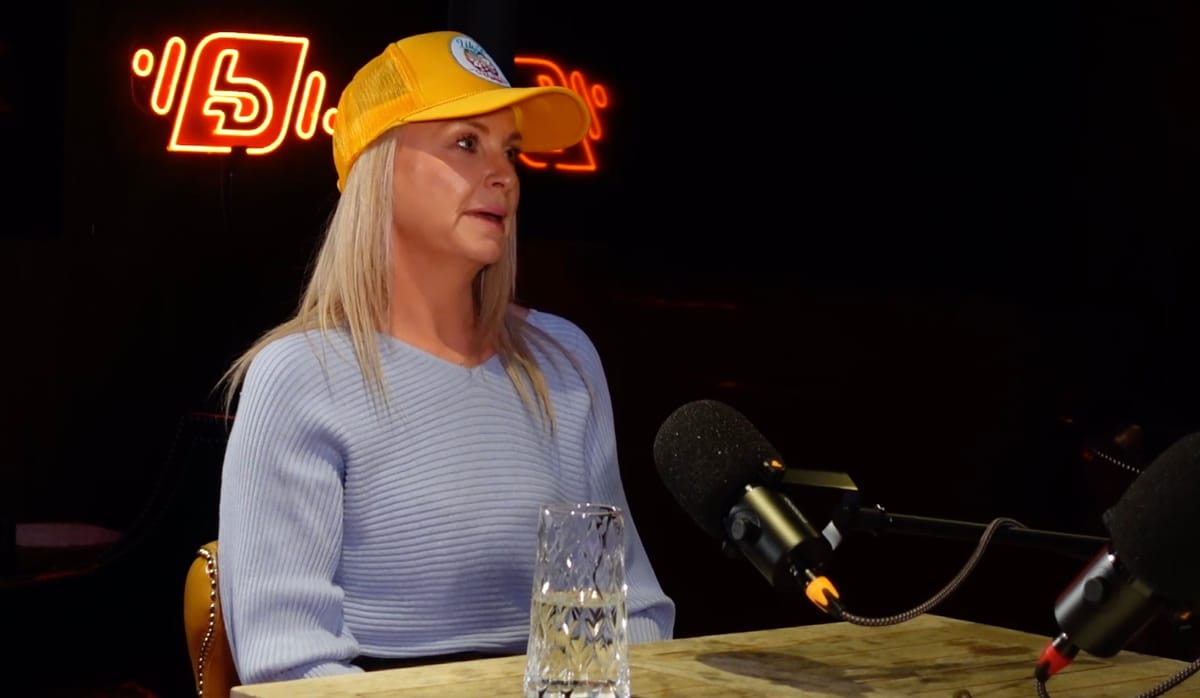
That is the backdrop to Lily’s Lighthouse, the nonprofit Sarah Kate founded to fund research into mushroom therapies for epilepsy. But the story does not begin with a nonprofit. It begins with a mother.
When her daughter Lily was having 50 seizures a day, Sarah Kate Boylan did what mothers do when medicine runs out. She went looking. What she found changed everything.
At first, Sarah Kate Boylan’s story feels almost impossible to process. Her daughter Lilly was diagnosed with epilepsy at five weeks old. For seven years, she had seizures every day. On average, 50 per day.
“She was having 50 seizures a day on average for seven years straight.”
That number is so brutal it's incomprehensible – every parents worst nightmare and Lily failed every available treatment.
“Lilly failed 13, 14, 15 different pharmaceuticals, "explains Sarah Kate. "I saw Lily completely out of her mind so many times in a toxic psychosis because the drugs were up so high. You should never see your child like that.”
There was brain surgery evaluation, but Lily was not a candidate. There was a VNS implant in her chest meant to interrupt abnormal electrical activity in the brain.
“It actually gave her different types of seizures.”
That is the backdrop to Lily’s Lighthouse, the nonprofit Sarah Kate founded to fund research into mushroom therapies for epilepsy. But the story does not begin with a nonprofit. It begins with a mother.
Before Lily's illness, Sarah Kate worked in law enforcement. She was trained as an intelligence analyst.
“Research was my capability. And I would find the solution to the problem.”
So when Lilly got sick, Sarah Kate did what came naturally. She built a case.
“When Lilly was diagnosed with epilepsy, it was already in my nature to start research," she says. “I compiled a complete intelligence dossier.”
She read everything from psychedelic research to functional mushroom research. Anything that might provide a clue.
“I speak fluent German, so I was able to decipher some of the studies that were done years ago.”
At first, she was not trying to save Lily as much as she was trying to improve her quality of life.
“Lilly was doing so badly I felt like I was losing her.”
So she landed on two functional mushrooms. Lion’s mane for cognition and Reishi because she believed it might act like an anticonvulsant. She sourced carefully and studied extraction ratios.
“Everything I do is methodical and purposeful and logical,” she says.
Then she gave Lily her first dose.
“When we gave her first dose, it was like we put a key in the lock and turned it and she was a different person.”
Lily went nine and a half weeks seizure free. Three therapists looked at her and asked the same question.
“What have you done with Lily?”
Before mushrooms, Lily had been so physically impaired that one of her therapy goals was simply to fall less.
“Her physical therapy goal was Lilly will navigate her environment and only fall once a day.”
She was falling 10 times a day. Bruised constantly. She could not get up and down stairs by herself. She needed a mobility service dog.
“Eight weeks after starting functional mushrooms, the physical therapist signed out that Lilly was of developmental age for physical therapy.”
Take the seizure count out of it for a second and the rest still feels enormous.
“It was like she was completely unblocked.”
Sarah Kate’s neurologist was stunned. After seeing Lilly’s response, he wanted the case published.
That case report now exists in a major pediatric neurology journal, documenting what happened when Lily was treated with functional mushroom extract powder. The reported result was a 99 percent seizure reduction.
“It was in that time that I filed nonprofit status.”
“One in 26 Americans have epilepsy,” Sarah Kate says. “One third diagnosed, no available treatment option works.”
Sarah Kate knew she was might have data to support a possible solution to a very serious problem.
“I felt like I wouldn’t be able to live with myself if I just was like, oh well, I healed my daughter.”
Now Sarah Kate is funding research, collecting data, partnering on studies, and hearing from families around the world. Some are seeing seizure reduction. Some are seeing improved cognition. Some are simply seeing a better quality of life than they thought possible.
“When you’re looking at people, especially within the drug-resistant epilepsy cohort, who failed every mainstream treatment available, they have nothing left.”
That is the group she is speaking for – the families who have run out of options.
Sarah Kate knows what it costs to tell this story over and over.
“Every time I speak about this, it brings the trauma up for me.”
Sarah Kate tried to define what entrepreneurship means to her. Her path to this moment was not conventional.
That may be the hardest part of the whole thing. “It takes a piece of me every time because I’m having to recall and remember how bad Lily was.”
Then she drops a line that sounds familiar to most entrepreneurs.
“Purpose through pain.”
At one point in our conversation, Sarah Kate tried to define what entrepreneurship means to her. Her path to this moment was not conventional. Law enforcement to citizen scientist to nonprofit founder is not exactly a straight line.
“I believe Lilly’s journey was meant to happen. I believe that no available treatment was meant to work for her, that the whole purpose was for her to help others.”
Sarah Kate on how she took matters of her daughter's health into her own hands.

Comments ()