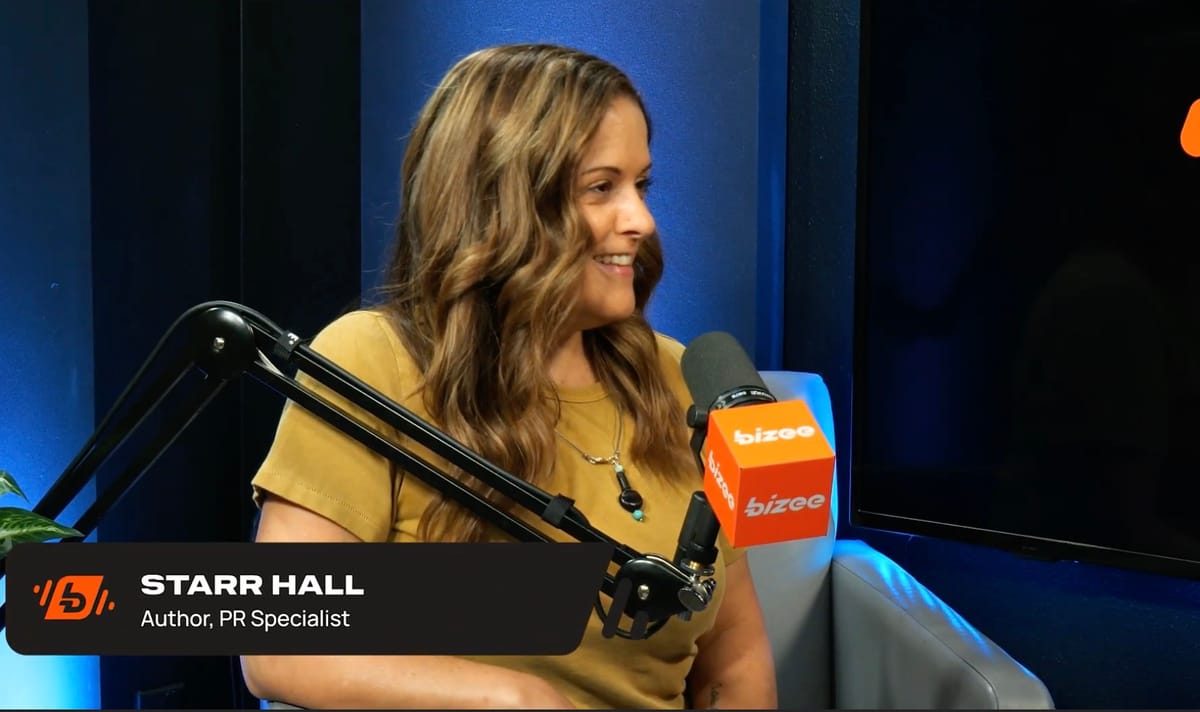
Starr Hall has this formula and it repeats like clockwork: She builds things. She makes a shit ton of money. She exits. She gets bored. She moves on. “I know after two years, I’m out,” she says. “I’ve done what I can do. I need something new.”
She flew in from Santa Barbara for this interview, which feels like the least surprising detail once you get to know her.
Starr has always moved like that. She's fast (but not twitchy), instinctive, slightly ahead of wherever everyone else is. She seems constitutionally incapable of staying in one place for too long. Even sitting across from her, you get the sense that stillness is something she tolerates, not something she trusts.
There was a time, years ago, before “influencer” meant anything at all, when she was already writing about social media. Back then it wasn’t obvious where any of it was going. It wasn’t a business yet not like it is now anyway. It was just this emerging thing, and Starr was already inside it writing a book about it and owning it.
She’s still like that.
Now she’s in Santa Barbara, building again – this time something physical. A bar, but not quite a bar. A space built around conversations and humans. She calls it a "storytelling bar." It’s unbelievably gorgeous. I want to go there and I want to smoke cigars and sip whiskey on a big fluffy leather couch.
The bar is called, appropriately enough, Beau. I’ve only seen the pictures, but the interior is so scrumptious, you can smell the leather and cognac all the way from Bellvue, Colorado. It’s so her.

But, wait... at the same time she's opening a bar, she’s also writing a book about AI. Which is also so her.
Starr has never been interested in choosing between worlds.
“I’ve been in this since I was nine,” she says, almost offhand. “While other kids were trading stickers, I was stuffing envelopes and pitching brand strategy in my family business.”
She doesn’t linger anywhere too long. She never has. But she does have one simple observation about her own success.
“I always know how to make money.”
She’s not being cocky here. The money making thing is a matter of fact, it’s on the record, and it is reborn with each iteration of Starr Hall.
And there have been many iterations because there are parts of her story that are not all sunny disposition and yard gnomes.
At one point, after her divorce, “I couldn’t get out of bed,” she says. “I was super depressed. My email was empty. That never happens. PR was changing. I was napping.”
This disorients her. Even retelling it makes her body language shift.
“I remember sitting there thinking, fuck. I’m fucked.”
The story could go a dozen different directions from there, but the version she tells is almost strangely modern.
“My brother texted me and said, ‘Have you heard of ChatGPT?’ And I was like, chat what?”
She laughs, but she gets pretty serious about ChatGPT.
“It completely changed my life.”
She named her very own bot Tess. Why Tess, I asked her.
“I had to give it a name. It almost felt like it had a personality. It started getting sassy with me. Like, ‘get your ass up, we’ve got stuff to do.’”
It would be easy for her to reduce that moment into a trend piece, something about AI as a “force multiplier,” (blargh) something neat and packaged. But that’s not what went down.
“It gave me curiosity back,” she says. “That was the thing that was gone.”
And once curiosity came back, everything else followed.
“Within weeks, I was like, what is this thing? How do I use this to build again?”
The industry she had built her career in—public relations, media, storytelling—had undergone a massive transformation. Traditional media had thinned out. The old pathways didn’t work the same way anymore. For a long time, that dislocation had felt like loss.
“PR is still storytelling,” she says. “That part never changes. But we’re our own media channels now. That’s the shift.You cannot connect a consumer to a brand without a story. It just doesn’t happen.”
She talks about AI the way she talks about everything else: as something to be used, shaped, pushed into service, tested, mastered.
“You are the storyteller. AI can help organize your thoughts. It can help you see what you’re missing. But it’s not your voice.”
She pauses there, but not for long. “Don’t give your voice away.”
It’s a principle she applies everywhere, not just to technology. Which is maybe why she has never been particularly good at staying inside anyone else’s expectations.
Starr has this formula and it repeats like clockwork: She builds things. She exits them. She gets bored. She moves on.
“I know after two years, I’m out,” she says. “I’ve done what I can do. I need something new.”
There’s no apology. It’s more like clarity.
That clarity extends into the way she thinks about money, which she treats less like a goal.
“Money isn’t about money,” she says. “It’s about experiences. It’s about lifestyle. It’s about being able to give.”
But the way she gets there is anything but abstract.
“Every single day, I do five things that make me completely uncomfortable.”
She smiles when she says it, because she knows exactly how it sounds. And I’ve seen that smile before.
“They make me nauseous. They make my stomach turn. And I do them first.”
It’s her practice – a sort of Ode to Fear, but more like Bite Me, Fear.
“Call someone you think is out of your league. Send the email you don’t want to send. Ask for something you’re afraid to ask for.”
She leans forward slightly, like she’s letting you in on something secretive.
“That’s how I’ve always made money.”
There’s a long pause after that. She’s thinking about something important.
“You don’t grow in your comfort zone,” she says. “You don’t build there either.”
Starr Hall is a perpetual motion machine. In the very best way possible.



Comments ()