The Good Pizza guy
“I went to investors,” he says. “No, no, no, no, no. Always no.” At the time, he thought they were wrong. “I said, what asshole, all these people,” he says, laughing.
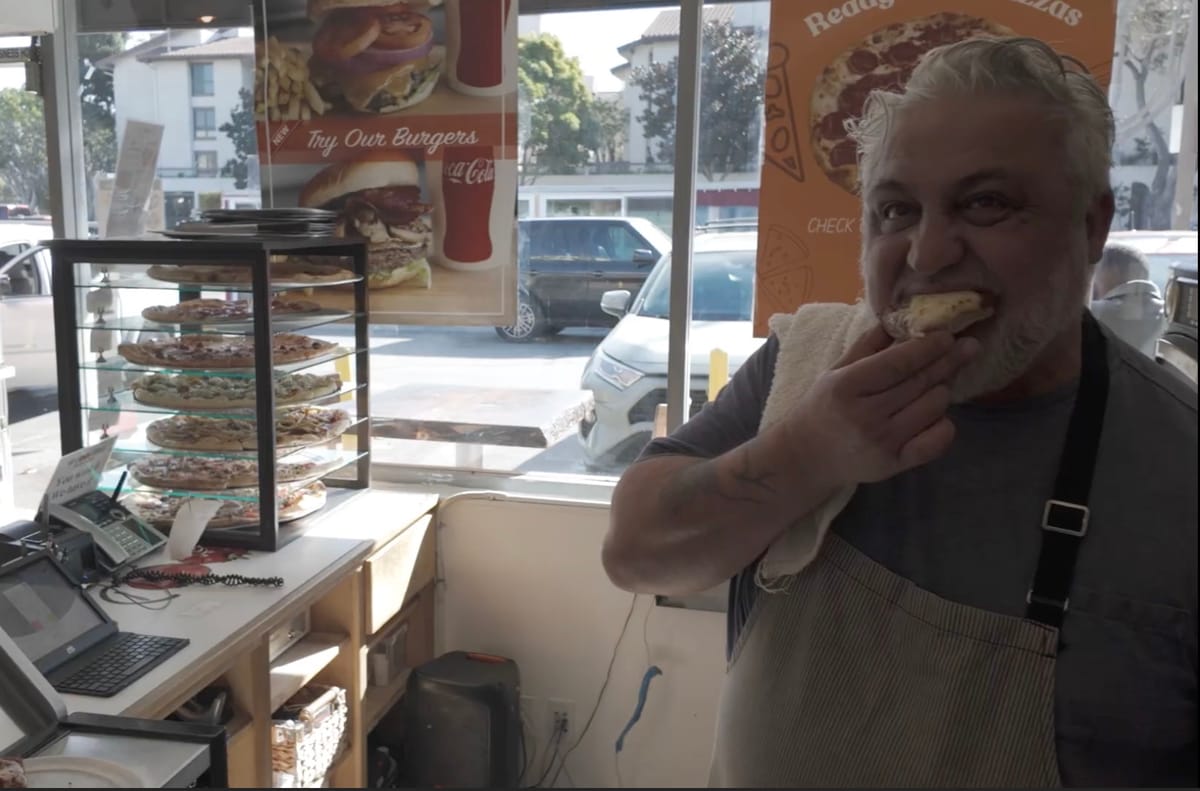
He arrived with no English, no money, and no plan
It was nine in the morning when I sat down with him at his tiny restaurant in LA, a light drizzle added to the ambiance.
The restaurant wasn’t open yet, but it was already a bustling scene. The ovens were humming and, in the back, deliveries started arriving.
We spoke Italian at first because how often do I get to whip out the old Italian? Not too often, truth be told.
Impressed with my efforts more than my Italian, he smiled, reached for my hand, and kissed it – Italian style.
We sat at a small table against a shelved wall filled with Chianti and olive oil. He leaned in when he spoke, a thick Italian accent on full display – exactly how you want your neighborhood pizza guy to sound.
His name is Ferdinando De Stefano, but everyone calls him Nando. He is the owner of The Good Pizza, a tiny neighborhood restaurant tucked into a strip mall in LA.
He starts his story with his humble beginnings in Naples, Italy. “Napoli,” he says.
“It is not safe here,” he says of Italy at the time. “So I didn’t have a choice. I left.”
He arrived in New York in the middle of the night, March 8th, 1998.
“I expected to see skyscrapers, lights everywhere,” he says. “I get out of JFK, it was pitch black, cold, raining. I was like, where is New York?”
He laughs when he says it.
“I was like, oh my God. What am I going to do now?”
A woman from the plane, an American who spoke Italian, saw him before he disappeared into the confusion of it all.
“She said, hop in the cab with me,” he says. “And we go to Manhattan.”
From there, he made his way to Westchester County, where he found a restaurant job.
“I started as a busboy,” he says. “I couldn’t work in the kitchen. I couldn’t speak English or Spanish. So busboy. Zip your mouth. With sign language, you work.”
He was making twenty dollars a day, aspiring to one day be a servers or even hit the big leagues as a bartender.
“I saw they were making money,” he says. “And I said, I got to learn English. I told everybody, if you want to come out with me, you speak English with me,” he says. “Otherwise, go.”
For six months, he cut himself off from Italian entirely.
“My word at that time was repeat, repeat, repeat,” he says. “They say something, I repeat until it stays in my brain.”
Within eight months, he had moved onto the floor as a server, taking on a small station at first and then more as his language and confidence grew, and from there the path continued west to a new time zone in California.
“I worked in Beverly Hills for many years,” he says. “And then I was tired. I said, I want to do something on my own.”
And he found an opportunity. Or, rather, he created an opportunity
“A little hole,” he says, smiling. “In Marina del Ray. There was a catering company in the morning,” he says. “From four to eleven. Then we take over from eleven to nine.”
That was the beginning of The Good Pizza in 2008.
“The people of Westchester [California], they greet us with a lot of warmth and love,” he says. “They supported us.”
The restaurant expanded from there.
“The word pizza is misleading,” he says. “People think it is just a pizza shop.”
He shrugs slightly, amused by it.
“In Italy, when you go to a pizzeria, you know you are not going to eat just pizza,” he says. “You have steak, fish, pasta, everything.”
Here, people walk in expecting one thing and discover something else.
“They try our food and they say, wow, I didn’t know you had this,” he says. “We thought you were just a regular pizza shop.”
He lets them discover it on their own.
“The culinary aspect for me is primary,” he says. “Pizza came after.”
He began making pizza in 1986, but his training is an ongoing, lifelong affair.
“My dough has evolved so many times,” he says. “It adapts to the time, to the weather, to everything.”
He grew up in Naples, Italy in a different kind of environment entirely.
“I grew up in the streets,” he says. “Either you fight or you get knocked out. There is no other way.”
He explains how that shaped him and his larger than life presence.
“I was not intimidated by anything or anybody,” he says.
That attitude carried him through the early years, through rejection.
“I went to investors,” he says. “No, no, no, no, no. Always no.”
At the time, he thought they were wrong.
“I said, what asshole, all these people,” he says, laughing.
Now he has a different opinion.
“I know now I was not ready,” he says. “If you don’t have the foundation, you’re not going to get there.”
So he built it himself.
“I worked seventy, eighty hours a week,” he says. “I saved, so when the time came, I didn’t have to ask anyone.”
He bet on himself.
For people coming behind him, especially immigrants, his advice is unvarnished.
“Put your head down,” he says. “Learn the language. Learn the system. Don’t be eager. Be patient.”
Patience, he says, is the key.
“Even if it takes two, three, four, five years,” he says. “Do your homework.”
Around us, the restaurant continues to wake up, the ovens now fully alive.
“In America, nothing is free,” he says. “You have to earn it.”
I stand to shake his hand and thank him.
“There is no other secret,” he says. “Work. Work. Learn. Experience over experience.”
Nando's secret to success: Hard work, focus, and good pizza.
Comments ()