Who is actually leading?
We built systems to help leaders think. Somewhere along the way, leaders started thinking like the systems. Seems dangerous,
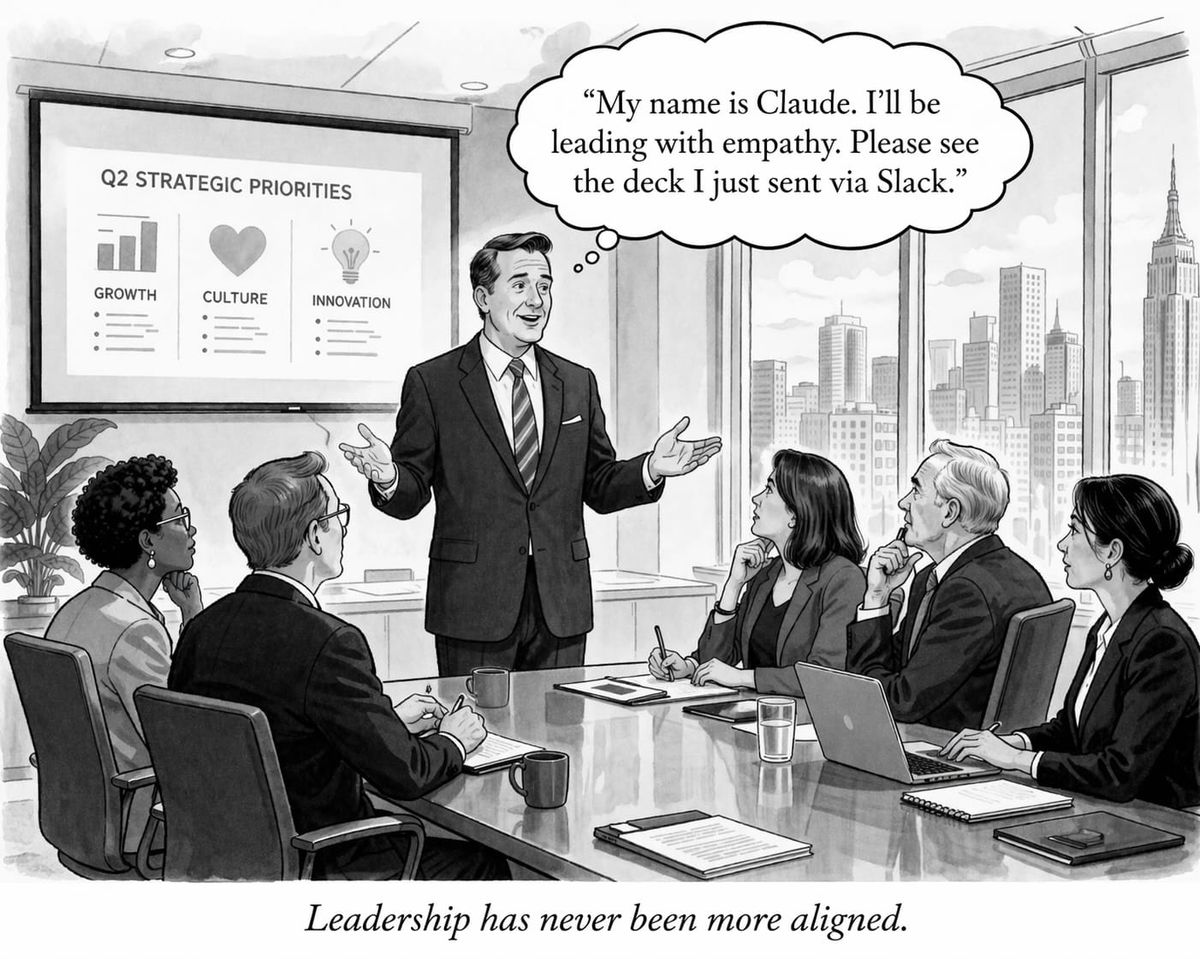
As AI gets better at producing answers, the people responsible for judgment are vanishing.
It’s a classic leadership question: Who would you follow into battle?
When I consider this question and look at industry and business leaders right now, I can confidently say absolutely no one. Zero. Literally not a single person. I would follow myself and myself only. I trust me and I’m good under pressure.
I keep trying to figure out how this happened. Business leadership seems to have collapsed into a closed loop. Leaders leading other leaders, speaking in systems, decks, and frameworks that never quite reach the rest of us. If something big happens or something fails, you don’t get leadership. You get a room full of leaders waiting for someone to lead – and talking it out amongst themselves while prompting an AI on what needs to happen next.
It’s hard – if not impossible – to inspire excellence and build trust under these conditions.
I fear we’ve created a generation of leaders optimized for managing systems, not people, and in some cases not reality. That’s a problem. It's also a classic leadership paradox – are you a leader or a manager? There's a vast difference.
I blame AI. Or, rather, I’d like to blame AI or at least wag a finger at it. I’m not entirely sure that’s fair, but it’s hard to ignore the possibility. There is a failure of consciousness in leadership and it can get pretty meta when you introduce AI into the discussion. Much like the pancaked, flattened, and horrendous writing populating pages these days, the same thing is happening in leadership. It's flat, lacks depth, lacks emotion, and doesn't instill a high degree of trust.
Decisions just feel thinner and flatter. Are they a bit more processed, too? Smooth and weird like Velveeta? It kind of tastes like cheese, but also chemicals?
And, alas, strategy is no longer explained by a human leader. In its place – a summary of inputs nicely sheltered in a Claude design, distributed via Slack. The flattification of leadership is afoot.
We need leaders who will inspire trust. We need leaders who will inspire greatness, innovation, originality. What we don’t need are leaders who take AI at its word for everything. What if the answers can’t be found in the data? What about the critical thinking component? Original thought, anyone?
We all know AI is very good at synthesis and patterns. It can take in massive amounts of information and return something that seems coherent, structured, smart, but on closer inspection, it falls apart. AI doesn’t always use good judgement. It's not supposed to. It's a machine with no consciousness.
Leadership is supposed to provide that layer of judgement and awareness. Instead, we’re starting to see the reverse. Leaders aren’t using AI to inform judgment, they’re deferring to it. Leaning a little too hard. Shaping their decisions around what the system produces instead of questioning it.
Which raises a question that’s been hanging out in my cerebral cortex for days.
Are leaders becoming agents of AI instead of the other way around? Who is making the decisions? Who is evaluating risk? Who is leading whom? Are we giving our consciousness to AI willingly?
Because if the answer is unclear, or even a little murky, then we have a much bigger problem than weak culture and cloudy leadership. - AC
Comments ()